

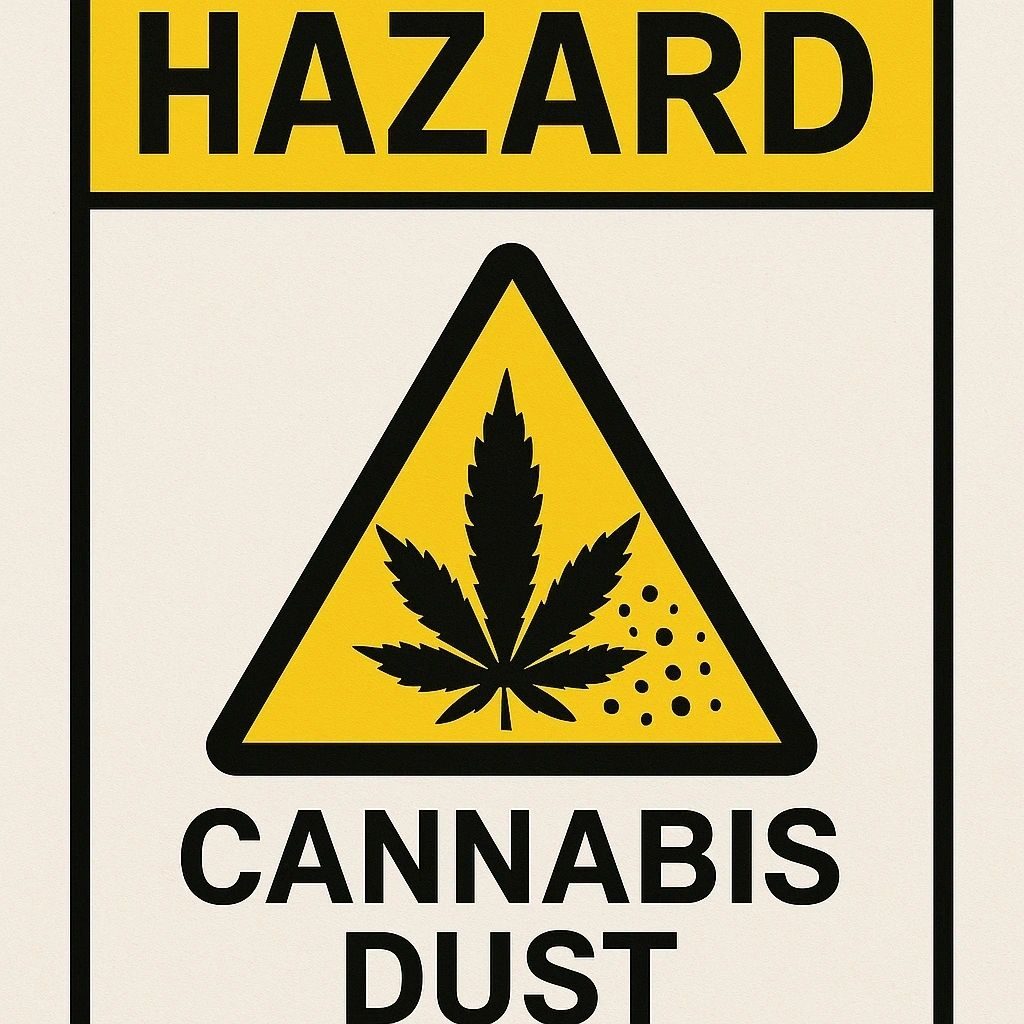
The Hidden Hazard in Cannabis Facilities: Dust
By Alex Hearding, Founder & President – Red Wolf Risk LLC
One of The Most Overlooked Threats in Cannabis Operations
When people think about hazards in cannabis operations, it’s easy to picture solvents, heavy machinery, lighting, or security. Yet one of the most common and least-understood dangers is something far less visible: airborne dust from cannabis plant material, especially in trimming, grinding, and packaging operations.
But this isn’t just a minor issue. There are documented deaths that show how serious it can be.
Two Fatalities that Should Sound the Alarm
1) Death from Occupational Asthma in Massachusetts
In January 2022, a 27-year-old worker at a cannabis cultivation and processing facility in Massachusetts died after a severe asthma attack that was determined to be triggered by her work in the grinding/pre-roll area. She had no prior asthma diagnosis, but after moving into grinding and pre-roll work (with cannabis dust exposure), she developed cough, wheezing, and worsening breathing problems. Investigators cited lack of ventilation, insufficient controls of cannabis dust, and inadequate training. This is the first known death in the U.S. cannabis industry attributed to occupational asthma from cannabis dust.
2) A Second Death Confirmed by California Health Authorities
According to the California Department of Public Health (CDPH) Occupational Health Branch, two workers in the cannabis industry are known to have died from new-onset work-related asthma. “They both worked around dried cannabis and did not have asthma before they started working in this industry. One death occurred in Massachusetts and the other in California.” While the California case is still under investigation for full details, the acknowledgement by a state health body is significant: cannabis dust is now clearly linked to fatal risk.
What Is Cannabis Dust and Why So Hazardous?
Cannabis dust refers to airborne fine particles of ground plant material, including trichomes, pollen, cellulose fibres, terpenes, and other fragments that result from trimming, grinding, milling, packaging or handling dried cannabis flower. These may become airborne in operations such as:
Trimming and bucking
Grinding/milling (flower to pre-roll, kief recovery, shake)
Weighing, packaging, sweeping production areas
Dry housekeeping or sweeping without proper controls
Once airborne, the dust can linger in the air, deposit on surfaces, get inhaled, and also carry allergens, terpenes, mould spores or endotoxins. Key hazard pathways include:
Respiratory sensitization: repeated exposure leads to occupational asthma or allergic rhinitis.
Skin / eye irritation: dust contact with skin or mucous membranes leads to rashes or conjunctivitis.
Mould/fungal contamination: humid plant environments + dust = mould spores and endotoxin exposures.
Combustible dust potential: while specific explosions from cannabis dust are less documented, fine organic dust in enclosed/dust-laden facilities is a known explosion hazard in other industries (grain, sugar, flour)
Regulatory & Industry Standards That Apply
While there is no U.S. federal standard specific to “cannabis dust,” the following regulatory frameworks apply:
Occupational Safety and Health Administration (OSHA) General Duty Clause (29 CFR 1910.5(a)(1)): Employers must provide a safe workplace from known hazards.
OSHA standards such as 29 CFR 1910.134 (Respiratory Protection) and 29 CFR 1910.94 (Ventilation) are relevant when dust exposures occur.
Any chemical or biologic hazard classification under Hazard Communication must be considered — and in Massachusetts, for example, ground cannabis dust was treated as a “hazardous chemical” after the fatality.
Industry best practices for housekeeping, local exhaust ventilation, HEPA-filtered vacuums and medical surveillance.
How to Protect Workers and Your Business
Mitigating cannabis dust risk must be strategic, it’s not simply housekeeping. The business risk is real: worker illness, fatality, wrongful-death suits, workers’ compensation claims, regulatory fines, insurance exposure, brand damage.
Engineering Controls
Install local exhaust ventilation (LEV) at grinding, trimming, milling, packaging stations.
Use HEPA-filtered vacuum systems to collect dust. Avoid dry sweeping.
Maintain negative air pressure zones or controlled airflow to keep dust from migrating.
Monitor air-borne particulate levels and allergen load (if available).
Design appropriate housekeeping and equipment maintenance schedules (e.g., cleaning filters, checking ductwork, verifying that step has been done).
Administrative Controls
Rotate staff away from high-dust zones to limit cumulative exposure.
Implement training: Make sure employees understand cannabis dust can cause asthma, allergic reaction, and that new/unexplained respiratory symptoms must be reported.
Establish early medical surveillance for new employees or anyone in high-exposure roles.
Track health incidents (coughing, wheezing, skin irritation) and respond swiftly.
Integrate dust-risk controls into your Quality Management System (QMS) and Worker Safety Program not a standalone add-on.
Personal Protective Equipment (PPE)
Provide and enforce use of N95/P100 respirators or better when engineering/administrative controls cannot reduce exposure sufficiently.
Provide goggles, face shields, protective clothing or coveralls that can be removed/washed.
Verify correct fit, training on use, maintenance of respirators. PPE is the last line of defense, not sufficient alone when design controls are weak.
Health Monitoring & Documentation
Baseline respiratory health screening for employees in dust-intensive areas.
Periodic follow-up screenings or monitoring of symptoms.
Document all exposures, controls, worker concerns, incidents. If there is any “new‐onset asthma” among employees, treat it as a red flag. Note: the Massachusetts case was new-onset asthma leading to death.
Maintain records of ventilation, dust collection system performance, training logs, incident reports. These become critical in insurance reviews, audits, and legal liability.
The Business Case: Why Dust Control is Smart ROI
Ignoring or minimizing the hazard of cannabis dust isn’t just a worker-safety issue — it’s a business risk with financial consequences:
Increased workers’ compensation and healthcare costs when respiratory illness occurs.
Regulatory fines and enforcement actions (as occurred after the Massachusetts fatality).
Insurance carriers may view insufficient control of dust and allergens as elevated risk, leading to higher premiums, reduced capacity, or exclusion of coverage.
Production disruptions, recalls, or contamination issues when dust or mould build-up occurs.
Damage to brand and reputation — worker deaths in your facility will draw external scrutiny, investor/capital concerns, and regulatory focus.
When you build dust control into your QMS/Worker Safety Program, you can demonstrate documented safeguards to insurers, regulators, and investors, turning a hidden cost centre into a defensive asset.
The Bottom Line
Dust from cannabis-processing operations isn’t benign. It’s a serious occupational hazard with documented fatalities, and it demands proactive mitigation. Operators who treat it as a housekeeping afterthought are exposing themselves to worker harm and major liability.
By integrating dust control into your operational framework:
You protect your people.
You protect your business.
You demonstrate control to regulators, insurers and the market.
In the evolving cannabis industry, operational readiness and risk transparency are competitive advantages. Dust control is a part of that readiness.
About Red Wolf Risk
Red Wolf Risk LLC helps cannabis operators, lenders, and insurers transform risk into ROI through the Operational Preparedness System (OPS), the only cannabis-specific program that connects compliance, safety, quality and insurance into one measurable framework.
Learn more at redwolfrisk.com
Alex Hearding is the Founder and President of Red Wolf Risk and has more than 17 years of experience in cannabis operations, risk management, quality systems, and regulatory compliance.
About the author
Written by Alex Hearding, founder of Red Wolf Risk. This piece is part of Chronic Risk, the insights publication of Red Wolf Risk.